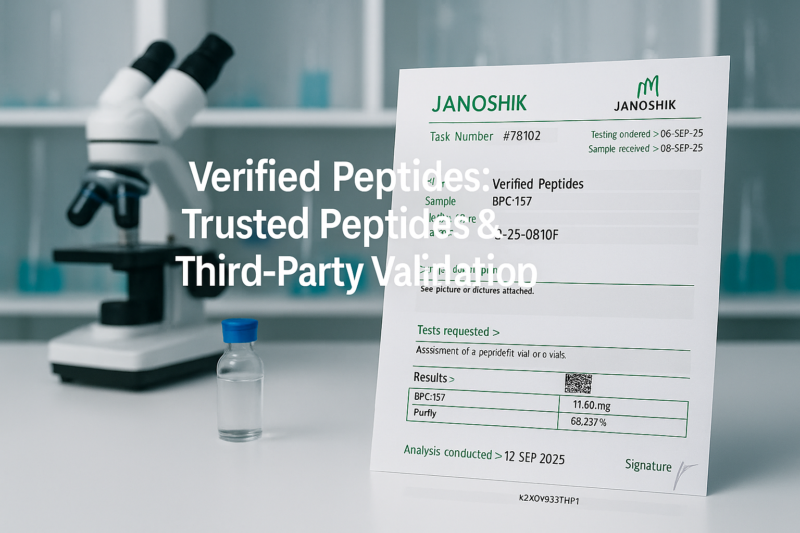
Peptide Pureness Determination Innovative Peptides-peptide Drug Exploration
Confirmed > 99% Lab-grade Peptides
Very couple of commercial study peptide vendors offer MS/MS information on regular COAs-- it is typically reserved for pharmaceutical-grade materials and progressed research setups. Nevertheless, some premium suppliers do offer it on ask for important batches. If sequence verification is vital for your study, this is the analysis to demand. It divides the elements of a sample based on their differential affinity for a stationary stage (column packaging product) and a mobile stage (solvent system relocating via the column). Peptides, with lengthy molecular sequences and varied conformations, existing obstacles for structure confirmation and web content determination. BOC Sciences leverages high-resolution mass spectrometry, LC-MS/MS, and NMR to properly evaluate molecular structures and provide extremely sensitive measurable support.Recognizing Peptide Purity Testing
- This is the grade where the boost most dramatically, due to the fact that achieving that last 1-- 3% of purity needs throwing out a significant fraction of the synthesized material.
- For instance, abbreviated peptides or chemically changed side-products might bind to targets or generate negative effects that amaze your results.
- All products are sold for study, lab, or analytical objectives just, and are not for human use.
- Either can be appropriate, but third-party screening is the gold requirement for research-grade materials.
- Really couple of commercial research peptide providers give MS/MS data on routine COAs-- it is normally reserved for pharmaceutical-grade products and progressed study settings.
- We offer HPLC and UPLC purity evaluation workflows that concentrate on useful separation rather than only generating a percent.
Complementing HPLC, labs use Mass Spectrometry (usually coupled as LC-MS) to validate the peptide's molecular weight and sequence identification. Mass spectrometry provides molecular verification by spotting the specific mass of the peptide and any type of co-eluting types or truncated series with high precision. With each other, HPLC and MS information enable analysts to verify that the peptide's structure matches what it needs to be (appropriate amino acid series and expected alterations) which no significant impurities are present.
Along with HPLC and MS, specialized laboratories might use orthogonal strategies for included accuracy. For instance, capillary electrophoresis can be made use of to divide really hydrophilic peptides or to confirm outcomes, https://articlegrovey.com/s/i1VP-yXYOBnWEdkVTTLOD and MALDI-TOF mass spectrometry can aid in mapping larger or customized peptides. Lots of peptide manufacturers or distributors will certainly offer a COA (Certification of Evaluation), for instance our bpc 157 tb 500 blend, that includes the purity portion by HPLC and identity verification by MS for every set. Top-tier labs often report peptide purity well over 95%, often ≥ 98-99%, by utilizing state-of-the-art HPLC and MS analyses. They likewise evaluate both raw materials and finished peptide vials, which aids capture any type of pollutants, degradation products, or formula variances.Residuals Screening
Not every application needs 99% pureness, and filtration is a significant element of peptide production expense. Trace amounts of solvents made use of during synthesis and filtration-- acetonitrile, dimethylformamide (DMF), dichloromethane-- can continue to be in the final product. These are commonly present at very low levels in correctly made peptides and are regulated by ICH Q3C standards for acceptable limits. If the target peptide's optimal accounts for 99.1% of the overall optimal area, the peptide is reported as 99.1% pure by HPLC. Several reliable study peptide providers make use of third-party labs; some conduct in-house screening with magazine of lab qualifications.Tests can be performed using high-precision stablizing chambers, mimicing various environments, and using worldwide standards to study temporary and lasting security, critical for regular peptide efficiency. Some peptides fall short not because the series is incorrect, yet since their physical habits in genuine solvents is inadequately recognized. We give physical residential or commercial property testing that aids groups function better with tough samples. Mass spectrometry confirms whether the measured mass matches the anticipated peptide mass. The chromatogram is the most crucial visual information element on an HPLC peptide examination report. It is a graph with time on the straight axis and detector reaction, typically UV absorbance, on the vertical axis.